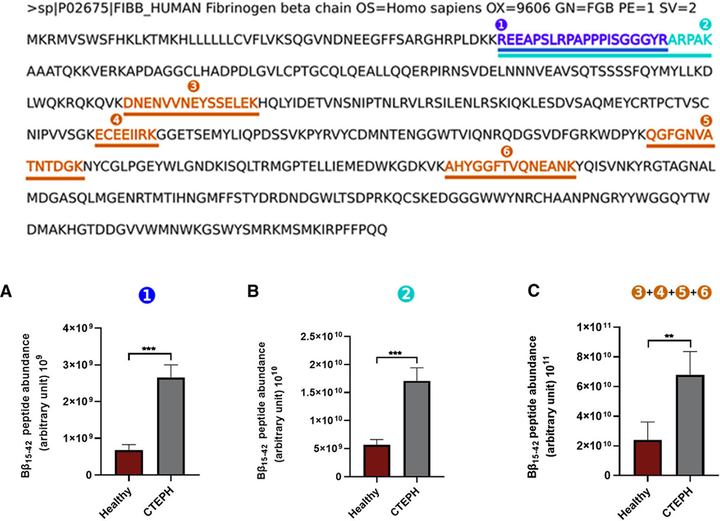
 Fibrinogen beta (FIBB) peptides in plasma of patients with chronic thromboembolic pulmonary hypertension (CTEPH) and healthy subjects © 2021 American Heart Association, Inc
Abstract
Objective
Thrombus resolution is driven by leukocyte recruitment and thrombus angiogenesis. An effective inhibition of leukocyte transmigration in vitro is mediated by naturally occurring peptide Bβ15-42, which is a competitive inhibitor of the interaction between the N-terminus of the fibrin beta chain and vascular endothelial cadherin. We investigated the effect of Bβ15-42 on thrombus resolution in a murine stagnant flow venous thrombosis model and studied Bβ15-42 levels in venous thrombus of human patients.
Approach and Results
We investigated 2 mouse models of subtotal inferior vena cava ligation. In the first model, we ligated the inferior vena cava. In the second model, we additionally ligated all visible inferior vena cava side and back branches. Study groups of 8 to 12 weeks old BALB/c mice were then injected intraperitoneal twice daily with 2.4 mg/kg of Bβ15-42, unrelated control peptide or saline. Bβ15-42 attenuated thrombus resolution after inferior vena cava ligation. We observed decreased numbers of thrombus macrophages and microvessels and less urokinase-type plasminogen activator expression in mice that were injected with Bβ15-42. Mechanistic experiments demonstrated that Bβ15-42 blocks monocyte transmigration through an endothelial cell monolayer. Measurements of Bβ15-42 in red clot and plasma of chronic thromboembolic pulmonary hypertension cases indicated high concentrations compared with controls.
Conclusions
Our data suggest that excess of the fibrin fragment Bβ15-42 misguides thrombus resolution, presumably by inhibiting vascular endothelial cadherin-mediated leukocyte migration during early thrombus organization.