Silicon mitigates potassium deficiency by enhanced remobilization and modulated potassium transporter regulation
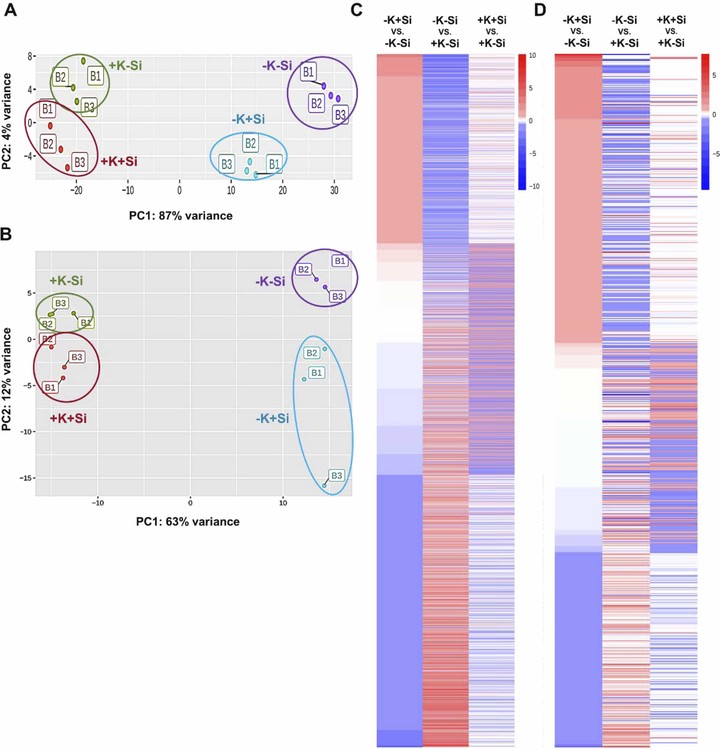 Changes in gene expression patterns of leaves and roots of barley plants as affected by K or Si supply © Nara Marella
Abstract
Silicon (Si) improves plant growth and development especially under stress conditions.
Highlights
- Mitigation of K deficiency by Si supply relies on an improved metabolic status of the leaves for sustained assimilate provision of roots
- Under K starvation, Si enables stronger depletion of the root K pool and enhances K remobilization for root-to-shoot translocation
- In K-starved plants, Si activates vacuolar K exporter genes in roots and subsequently stimulates the K
Although Si alleviates growth suppression and deficiency symptoms of several nutrient disorders, underlying regulatory processes have remained indefinite. In this stidy, we analyzed the impact of Si on nutritional, metabolic and transcriptional responses in roots and shoots of barley subjected to potassium (K) deficiency.
On the long run, Si nutrition improved root and shoot growth as well as metabolite homeostasis and partly reverted the K deficiency signature of the transcriptome back to adequate only in fully expanded leaves but hardly in roots.
In the short term, Si supply to K-starved roots enhanced first the expression of the vacuolar K exporter KCO1 together with root-to-shoot translocation rates of rubidium (Rb) that was used as tracer for K.
The typical K deficiency response, marked by upregulation of the K importer genes HAK1 and AKT1, set in a few days later but then at several-fold higher levels. Lower root K and higher shoot K contents in Si-supplied plants indicated more efficient remobilization of root K pools and higher root-to-shoot translocation, which on the long run restored K-dependent metabolic processes in shoots for the sake of continued assimilate provision to roots.
These results provide a sequence of physiological processes by which Si partially recovers plants from K deficiency and indicate that Si interferes with systemic K deficiency signaling in roots to alter the regulation of K transporters.