The polyamine-regulating enzyme SSAT1 impairs tissue regulatory T cell function in chronic cutaneous inflammation
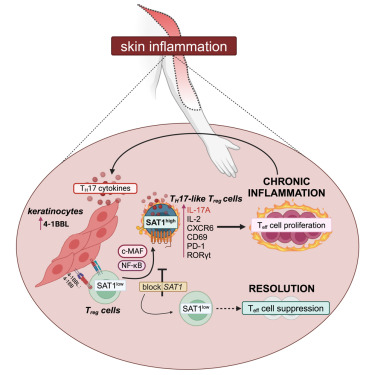 SSAT is a key driver of Treg cell dysfunction © Authors
Abstract
Regulatory T (Treg) cells are a critical immune component guarding against excessive inflammation. Treg cell dysfunction can lead to chronic inflammatory diseases with current therapies aimed at inhibiting effector T cells rather than rescuing Treg cell function. We utilized single-cell RNAsequencing data from patients with chronic inflammation to identify SAT1, the gene encoding spermidine/spermine N1-acetyltransferase (SSAT), as a driver of skin-resident Treg cell dysfunction. CRISPRa-driven SAT1 expression in human skin-derived Treg cells impaired their suppressive function and induced a pro-inflammatory phenotype. During cutaneous type-17 inflammation, keratinocyte 4-1BBL induces SAT1 on Treg cells. In a mouse model of psoriasis, pharmacological inhibition of SSAT rescued Treg cell number and function. Together, these data show that SAT1 expression has severe functional consequences on Treg cells and suggest a therapeutic target to treat chronic inflammatory disease.
Highlights
- Human skin Treg cell stability and function are controlled by SAT1 gene expression
- SAT1 hi Treg cells drive CD4+ effector cell proliferation
- Keratinocytes in a TH17 environment drive the SAT1hi phenotype in Treg cells via 4-1BBL
- Blocking SSAT rescues Treg cell number and function in a mouse model of psoriasis