A non-enzymatic role of Nudix hydrolase 5 in repressing purine de novo synthesis
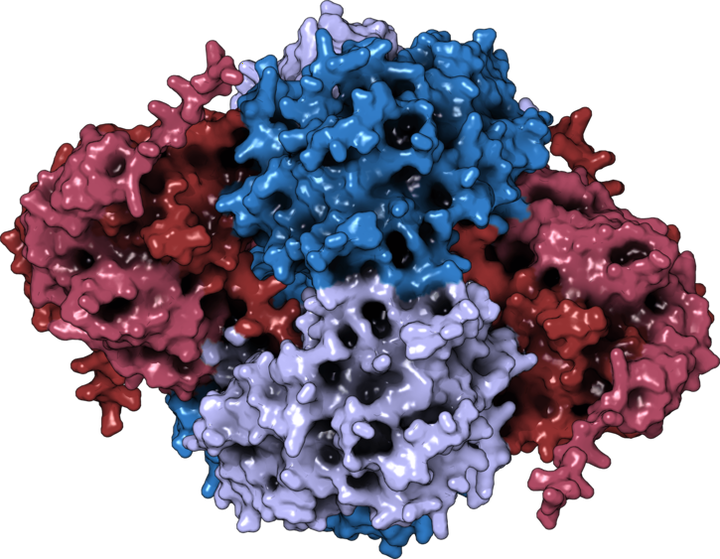 Alphafold interaction prediction between NUDT5 dimers (red) and PPAT tetramer (blue) © Tuan-Anh Nguyen
Abstract
Cells tightly regulate concentrations of purine nucleotides because they have important roles in cell proliferation, as components of synthesis of RNA and DNA, and in other cellular metabolic and signaling functions. Purines can be produced by de novo synthesis or by a salvage mechanism, and these pathways influence one another. In complementary work, Nguyen et al. and Wu et al. screened for gene products that influenced the de novo synthesis of purines and identified Nudix hydrolase 5 (NUDT5), a member of a superfamily or hydrolases that cleave nucleoside diphosphates. Characterization of NUDT5’s roles revealed that such enzymatic activity was not required in this context. Rather, NUDT5 appears to have another function in scaffolding the oligomerization of phosphoribosyl pyrophosphate amidotransferase (PPAT), the rate-limiting enzyme in de novo purine biosynthesis, and decreasing its enzymatic activity. The findings help to explain the mechanisms that balance activity of the synthesis and salvage pathways and have implications for therapeutic strategies that use purine analogs to combat cancers and inflammatory diseases